After centuries of ups and downs, the ancient communal houses in coastal localities to the east of Ho Chi Minh City - such as Vung Tau, Long Huong, Long Hai, and Phuoc Hai - still stand as living witnesses of the rich cultural and historical traditions.

Visitors at Thang Tam communal house call doves to the courtyard.
Today, the centuries-old heritage has become a driving force and resource in the process of positioning identity and cultural tourism development.
The beauty of village communal houses
At weekends, a coach carrying more than 50 visitors arrives at the gate of Thang Tam communal house (Vung Tau Ward, Ho Chi Minh City). In the courtyard of the communal house, tourists happily film and photograph the ancient architecture of the old communal house; another group of tourists scattered grains and called doves to perch all over the courtyard. Inside, another group of visitors follows their guide, offering incense and listening to explanations about the relics and traditional festivals at the communal house.
Thang Tam communal house, which is situated in a favourable feng-shui location, was first built in 1820. The original structure was made of bamboo and leaves, in 1835, local residents contributed to repairing and adding a tiled roof. In 1965, the communal house was restored and rebuilt to its current architectural structure. It is dedicated to three founders of the three villages in Vung Tau: Pham Van Dinh, Le Van Loc, and Ngo Van Huyen.
The communal house has a continuous architectural structure consisting of four interconnected buildings linked by a side walkway: the ancestral hall, the assembly hall, the central hall, and the performance stage. Inside, there are many finely carved ceremonial objects that gleam with red-and-gold lacquer. The ancestral hall is roofed with yin-yang tiles, decorated with a raised relief of "two dragons flanking a full moon." The ends of the rafters, purlins, and columns are all carved with dragon motifs.
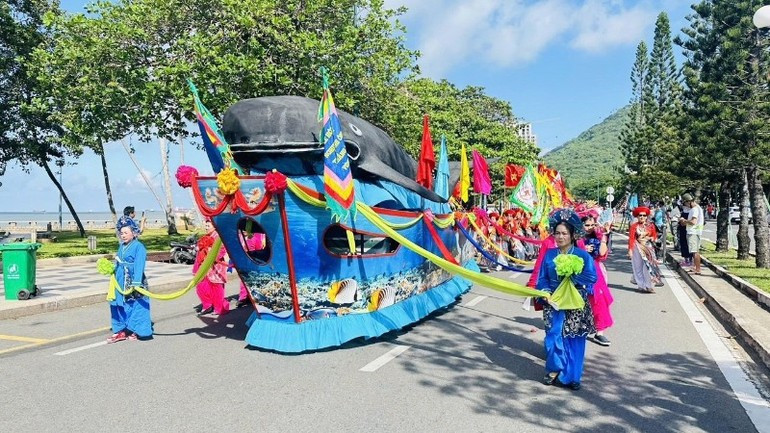
Traditional festivals held at the communal house have become distinctive tourism products.
Located near the river mouth and Ben Dinh market, Thang Nhi communal house is another site of long-standing cultural and historical significance. According to Mai Van Ba, who lives at 36/2 Ngu Phu in Vung Tau Ward, Ho Chi Minh City, he was born and grew up in Thang Nhi and has witnessed many changes in the area over the past years.
“Today, the streets of Thang Nhi have been widened and paved, becoming a bustling commercial centre, and people’s living standards have been improved. Thang Nhi communal house is still a place that honours the founders of the village with the spirit of ‘first near the market, second near the river,’” Ba said.
Long Huong communal house is one of the village communal houses more than 200 years old, located near the Dinh River (Long Huong Ward, Ho Chi Minh City). According to village elders, it was built in 1850. During nine years of the resistance war against French colonialism, the communal house sheltered and protected revolutionary cadres. Its grounds, shaded by tall ancient trees, were used by guerrilla forces as lookout points to monitor enemy movements from all directions, providing safe conditions for cadres to build the revolutionary facilities.
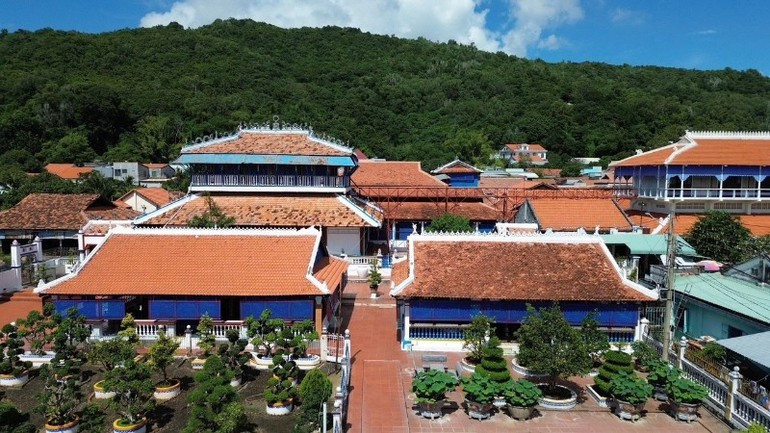
The cultural and historical values, together with the unique architecture of village communal houses, is a key factor to attract visitors.
Analysing the architecture of communal houses, architect Nguyen Duc Lap, Chairman of the Ba Ria - Vung Tau Architects’ Association, said that communal houses in the eastern area of Ho Chi Minh City typically form a complex of square buildings supported by four main pillars, or a traditional long house of three bays with two annexes. They are usually built on high and dry ground in a beautiful location, near the market, and convenient for transportation.
The communal house has a traditional four-pillar structure, extending outwards in four directions with evenly spaced, square-shaped crossbeams and purlins. The roofs are covered with yin-yang tiles, and the ridges are often adorned with colourful glazed ceramic figures depicting themes such as: two dragons fighting over a pearl, a phoenix holding a scroll, a mother lion teaching her cub, a fish transforming into a dragon.
Pham Chi Than, former Director of the Ba Ria - Vung Tau Museum, said that in the eastern area of Ho Chi Minh City, communal houses of fishing villages were often built next to temples, pagodas, shrines, and markets. They formed an economic–cultural–spiritual centre of the village, serving as a venue for village meetings and as places of worship dedicated to the village’s tutelary deity, natural deities, human deities, historical figures, and ancestors who contributed to the village and the nation.
“Because of this, the communal house becomes the heart of community sentiment, where villagers connect their feelings with the past, present, and future. Over time, the communal houses located by rivers and near markets have still existed as timeless cultural symbols and have become attractive destinations for visitors,” Than said.
Tourism connections
A network of 15 communal houses and ancient pagodas, representing architectural art and traditional festivals and reflecting the folk spiritual cultural identity of the Vietnamese people in the eastern area of Ho Chi Minh City, is now being exploited for tourism development.
Pham Ngoc Hai, Vice Chairman of the Ho Chi Minh City Tourism Association, said that with their diverse architecture and shapes, ancient communal houses can serve as a link between past and present culture. The communal houses were once centres of community life and today still form an essential part of local spiritual traditions. For this reason, in recent years, travel agencies have incorporated communal houses into tour routes so that visitors to the coastal wards and communes of Ho Chi Minh City can appreciate the cultural essence of ancient traditional communal houses in Vietnamese village.
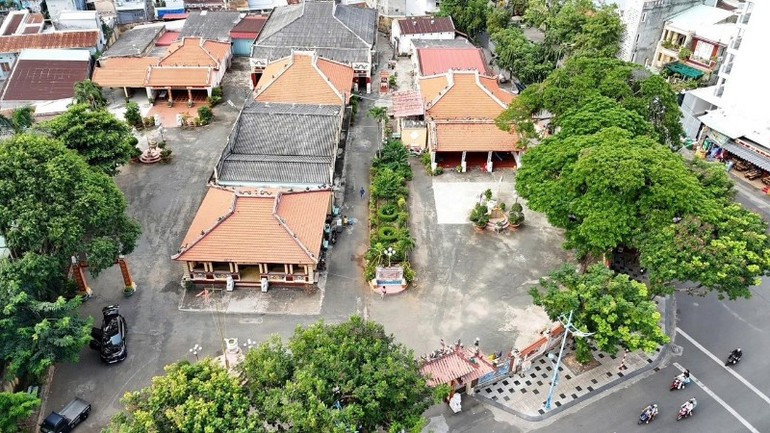
An overview view of a communal house
From a local perspective, Vu Hong Thuan, Chairman of the People’s Committee of Vung Tau Ward, said: “Besides tourism products such as swimming, sports, entertainment, and modern leisure activities, incorporating the traditional beauty of communal houses into tourism development is a priority for the locality. Particularly in recent years, festivals held at communal houses, such as the Nghinh Ong festival at Thang Tam communal house, have been developed as a unique tourism product that both promotes national intangible heritage and attract domestic and international visitors. Thanks to that, the number of tourists to Vung Tau has increased steadily over the past years.”
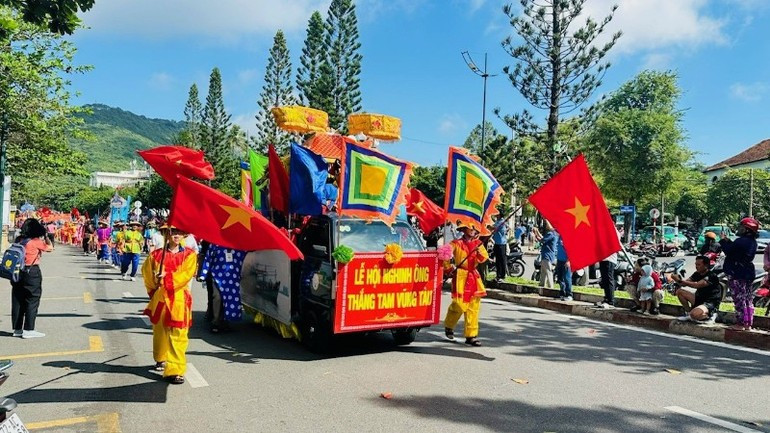
The Nghinh Ong festival
However, to unlock the tourism potential of communal house heritage, is still a challenging task, requiring creative approaches and the combined efforts of communities, authorities, and businesses.
According to Le Hong Tu, Director of BT Tour, a community tourism and event organisation company, to turn communal house heritage into an attractive destination, infrastructure and services must first be improved synchronously, especially the involvement of local authorities and communities in restoring and preserving the landscape, environmental sanitation, and organisation of training courses on tourism for local people.
In addition, cooperation with travel companies is essential in developing products and designing tours that feature communal houses with notable cultural value.
In the long term, it requires appropriate mechanisms and policies to encourage the community to participate in protecting and promote communal house heritage values so that they become branded cultural tourism products.
Phu My - Translated by NDO