Ho Chi Minh City has launched a transformative "locality as a tourism ambassador" model that mobilizes 168 wards and communes to transform local heritage and daily life into sustainable travel experiences.
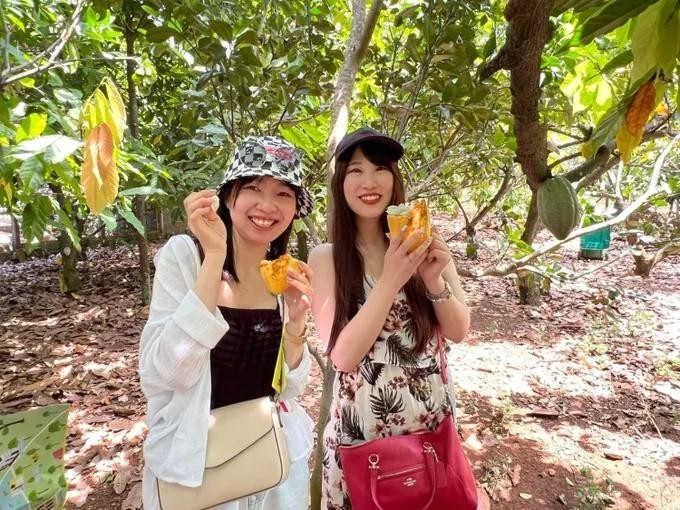
International tourists are thrilled to tour and harvest cocoa directly at orchards in Ho Chi Minh City'S Chau Duc Commune
Each commune and ward is not just a simple tourist destination. The "locality as a tourism ambassador" model, implemented by Ho Chi Minh City's tourism industry in 2026, is expected to open up an effective and sustainable way to develop community tourism.
Orchard experiences drive farmer profits
On weekends, Mr. Tham's longan orchard in Phuoc Hai Commune, Ho Chi Minh City, welcomes dozens of visitors who come to tour, experience, and enjoy longan fruit in the orchard. Tourist Le Thi Dung from Lam Dong province said that she learned about Mr. Tham's longan orchard through news and the internet, so she took the opportunity to visit and experience the orchard during her trip. "This is the first time I've learned about the process of caring for longan trees, and I got to pick ripe longan fruit myself to enjoy right in the orchard. When I have the chance to return to Phuoc Hai, I will continue to visit this place and introduce this experiential tourism model to my friends," she expressed.
Pham Tham, owner of the longan orchard, said that since 2022, his family's longan orchard has been selected by the local authorities as a community tourism destination, so it has opened its doors to visitors for sightseeing and experiences. Since the model started operating, the number of visitors to the orchard has been quite high, with an entrance fee of VND50,000 per person, allowing visitors to combine sightseeing with enjoying longan fruit in the orchard. “Although this model is new, it has brought profits to farmers. Visitors come here not only to visit and enjoy the fruit in the orchard but also to buy it as gifts for relatives and friends,” Mr. Tham shared.
Meanwhile, in Long Dien Commune, traditional crafts such as the An Nhut rice noodle making and the An Ngai rice paper making also offer unique local products to promote community tourism development.
There are hundreds of thousands of delicious dishes, but as tourists travel east of Ho Chi Minh City, they immediately think of trying the delicious specialties of this region. An Nhut rice vermicelli is one of those local specialties. On weekends, the An Nhut rice vermicelli shop is packed with tourists.
Ms. Tran Thi Anh Dao, owner of the An Nhut rice vermicelli shop, said that her family has been making rice vermicelli for three generations. Word spread, and An Nhut rice vermicelli became well-known. From a small shop, it now welcomes hundreds of customers every day. “On weekdays, I use 200kg of flour to make the vermicelli, and on weekends, it's 300kg to serve all the customers. During Tet (Lunar New Year), the amount of flour used sometimes increases to 400kg/day,” Ms. Dao said.
Leaders of Long Dien Commune reported that since 2000, the traditional An Nhut rice vermicelli and An Ngai rice paper making have attracted many tourists, especially international visitors, to explore and experience, contributing to the development of tourism in the eastern part of Ho Chi Minh City.
Recognizing the growing demand from tourists, many organizations, agencies, and travel companies have developed tours and destinations in the traditional craft villages of An Nhut (rice noodle) and An Ngai (rice paper), allowing visitors to enjoy freshly made rice noodles right from the oven and experience the handcrafted process from pressing the dough to shaping, steaming, and drying the noodles seeing that each noodle is a part of a story, a slice of the culture of this land.
Traveling and hearing stories of the homeland
Bau Lam is a remote commune of Ho Chi Minh City, where tourism is developed from existing foundations - the unique culture of the Cho Ro ethnic group, and high-quality processed pepper products, the main crop of the area, that have been transformed into OCOP products for tourists.
The People's Committee of Bau Lam Commune is pivoting toward an experiential tourism model that leverages both traditional values and modern agricultural innovation. Chairman Tran Van Dung revealed that the local strategy focuses on empowering residents to share their heritage directly with visitors. By incorporating the Cho Ro cultural space and local OCOP (One Commune One Product) specialties into dedicated tour routes, the commune seeks to link traditional values with high-tech farming to enrich the visitor experience.
Chairman Tran Van Dung emphasized that this initiative serves as a vital channel for the promotion and sale of local agricultural goods. Moving forward, the commune plans to intensify trade promotion activities for its OCOP portfolio, ensuring that specialty products are effectively introduced to the tourism market.
Meanwhile, Phuoc Hai Commune, with its advantage of a coastline longer than 3km, along with its fishing industry and unique coastal festivals, is also seeking its own direction for tourism development. According to Nguyen Hong Phuc, Vice Chairman of the Phuoc Hai Commune People's Committee, the locality is focusing on a dual-track strategy including the rigorous preservation of historical and cultural relics coupled with active community engagement. To promote the image and develop the local tourism brand, the commune is implementing new support mechanisms that encourage residents to participate directly in the tourism value chain.
By integrating ancestral traditions with modern hospitality, Phuoc Hai seeks to create an authentic destination identity. In addition to preserving and promoting the values of heritage, Vice Chairman Nguyen Hong Phuc revealed, the administration is providing the necessary resources to ensure that local people are not just observers, but active stakeholders in the commune’s burgeoning tourism industry.
According to the Ho Chi Minh City tourism development plan for 2026, one of the important tasks identified by the Department of Tourism is to innovate tourism promotion and advertising. A new and groundbreaking aspect is mobilizing 168 wards, communes, and special zones to participate in the digital media ecosystem to tell the unique story of each locality to tourists.
The Department of Tourism will organize communication skills training for wards, communes, and special zones, focusing on building communication channels and strategic cooperation skills with major digital platforms such as ShopeeFood and TikTok Vietnam.
By Quang Vu - Translated by Anh Quan